
When hospitals faced a desperate shortage of ventilators during the COVID-19 pandemic, a young Indian robotics company took on a challenge far removed from its original business. Noccarc, founded by IIT Kanpur alumni, turned its engineering capabilities toward critical care equipment. What began as an emergency response has since developed into a commercial medical technology enterprise serving hospitals across India.
A Change of Direction in a National Emergency
Noccarc was originally associated with robotic systems for cleaning solar panels. During the pandemic, its founders, including Nikhil Kurele and Harshit Rathore, shifted their attention to the need for locally manufactured ventilators. IIT Kanpur’s engineering ecosystem supported the effort, bringing technical expertise and institutional collaboration to an urgent public health problem.
The development effort led to an indigenous ICU ventilator and subsequently a wider medical equipment portfolio. The story is not simply that engineers designed a prototype. The company moved into manufacturing, hospital supply and ongoing product development, all of which are essential for an invention to make a difference beyond the laboratory.
From Prototype to Hospital Adoption
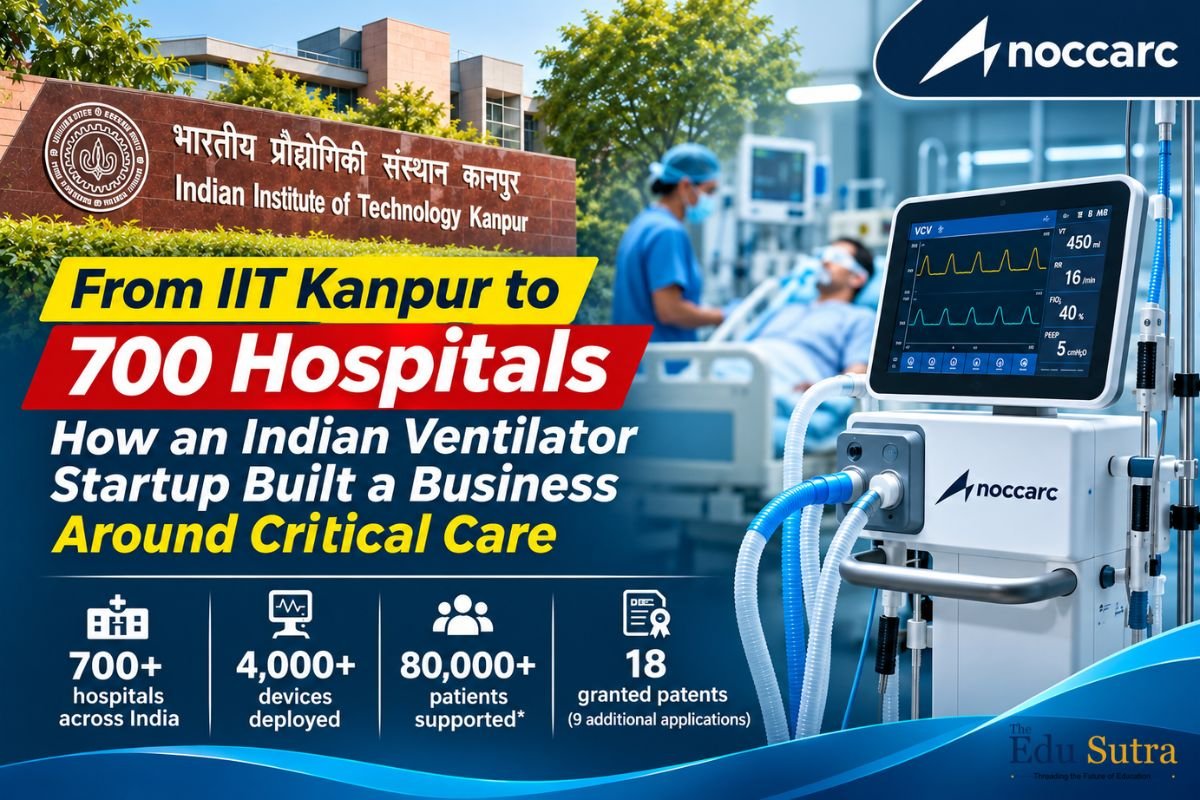
In an independent profile published by ThePrint on August 7, 2026, Noccarc’s equipment was reported to be in more than 700 hospitals across India. The company’s own published figures describe more than 4,000 devices deployed and over 80,000 patients supported. These latter figures are company-reported and should not be read as an independently audited count of patients whose lives were saved.
The business has also expanded beyond ventilators into other critical-care equipment, including patient monitoring products. This matters because sustaining a medical technology company requires much more than responding to a one-time emergency: hospitals need dependable equipment, service support, training and continued innovation.
Patents, Research and Commercial Evidence
Noccarc’s website reports 18 granted patents and nine additional patent applications across its technology portfolio. Those totals have not been individually reconciled with official patent registers for this article, and they should not be interpreted as proof that every product is covered by a granted patent. The company’s hospital deployments offer stronger direct evidence of commercialization.
Also Read:- From IIT Madras to ₹22 Crore Business: How an Indian Innovation Is Transforming Lives Through Mobility
The company has described itself as profitable in reporting during 2026, but independently audited revenue and profit figures were not established for this feature. Accordingly, its commercial achievement is best described through its reported hospital reach, deployed devices and continued product activity, rather than an unsupported valuation or turnover claim.
Why This Innovation Matters to Society
Critical-care devices can be costly and difficult to procure, particularly when international supply chains are disrupted. Domestic design and manufacturing can give hospitals additional sourcing options and help build technical capacity in India. For smaller cities and regional healthcare facilities, reliable access to equipment and after-sales support can be especially important.
There is, however, an important distinction between deploying medical devices and proving clinical outcomes. Publicly available figures cited here do not establish how many deaths were prevented or how much treatment costs fell. Those questions require hospital-level evidence and independent evaluation.
The Campus to Commerce Lesson
Noccarc illustrates the path that research-linked entrepreneurship must travel to achieve real-world impact: identify an urgent problem, develop a technically credible solution, manufacture at scale, reach paying institutional customers and support the product after installation.
Its story also reflects the value of IIT Kanpur’s wider innovation environment, where academic expertise and entrepreneurial initiative can intersect. For India’s universities, the larger lesson is clear. The success of an invention is measured not only by the idea or its patent status, but by whether it becomes a useful, dependable product that reaches people who need it.
As IndiGlobal Campus to Commerce begins documenting Indian innovations that have reached the market, Noccarc offers a compelling example: engineers responding to a national emergency, and building a continuing healthcare business from that response.