
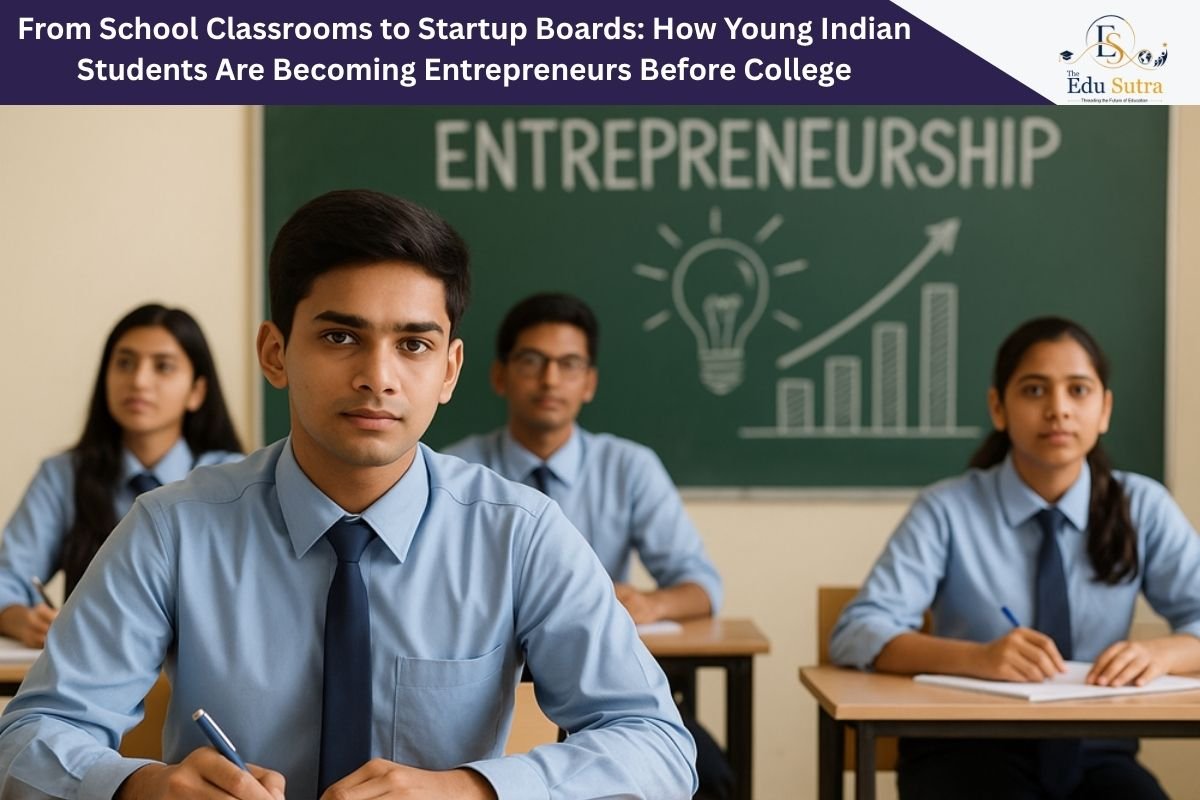
Punjab: A new generation of young entrepreneurs is emerging from an unexpected place, school classrooms. Across India, students are no longer waiting until college to experiment with business ideas, build products or pitch their ventures. Entrepreneurship programmes are giving school students an early opportunity to identify real-world problems, develop solutions and take their first steps into the startup ecosystem.
One of the strongest examples is emerging from Punjab, where the Business Blasters programme has helped government school students turn classroom ideas into potential businesses. At IIT Ropar in Rupnagar, some of these school-born ventures have moved beyond competitions and entered a formal incubation environment.
One such story is that of Arjun Chaudhary, who began working with his classmates in Class 11 on a rechargeable electric bicycle. The team secured ₹4 lakh in funding after being recognised among the top performers at the Punjab Business Blasters State Summit. Their idea was subsequently selected for a year-long incubation programme at IIT Ropar.
The experience exposed the students to much more than technology. With technical and business mentorship, they worked on improving the bicycle’s battery system, reducing costs and understanding customers, marketing and product presentation. The venture has since been registered as AC Rockers LLP and has received nearly 60 orders.
When school ideas enter the real startup ecosystem
IIT Ropar’s Technology Business Incubator Foundation has become an important bridge between school-level innovation and higher education. According to the institute, 19 student-led ventures originating from school entrepreneurship programmes have entered incubation.
The aim is not simply to reward students for winning competitions but to help promising ideas survive beyond the classroom. Students can gain access to technical expertise, infrastructure, mentors and business guidance, resources that can be difficult for young innovators to access on their own.
This approach is particularly significant for government school students, as it can help reduce the gap between talent and opportunity.
Entrepreneurship is spreading beyond Punjab
The movement is not limited to one state. Programmes such as Kaushalam in Uttarakhand, Kushal Business Challenge in Haryana and Tejasvi in Madhya Pradesh are encouraging students to identify problems, develop solutions and pitch business ideas while still in school.
Udhyam Learning Foundation, which has worked across 15 states since 2017, says its initiatives have reached more than 4.7 million students and 50,000 teachers.
For many students, the experience is becoming more than an extracurricular activity. It is giving them an opportunity to understand customers, teamwork, failure, money and problem-solving much earlier than traditional education normally allows.
Universities are opening their doors earlier
The school-to-startup connection is also extending into universities.
At Plaksha University, the Young Technology Scholars programme gives high school students hands-on exposure to areas such as artificial intelligence, robotics, biotechnology and computer science, supported by faculty mentorship.
Ashoka University is similarly engaging school students through programmes focused on liberal arts, sciences, independent thinking and solving real-world problems.
The larger idea is simple: innovation does not necessarily begin after a student receives a college admission letter. Curiosity, experimentation and entrepreneurship can begin much earlier.
Not every startup becomes a success, and that’s okay
The journey also comes with failures.
Krishna Rathore began a home décor venture called YUDECOR while in Class 11 through Delhi’s Business Blasters programme. His candle business eventually generated an estimated ₹10–15 lakh in sales, but sustaining the venture became difficult when he entered college and had to manage the business largely on his own.
Rather than treating the experience as a failure, Rathore described it as a learning experience that helped him understand branding, customers, teamwork and long-term planning. He has since started another venture, applying the lessons from his first attempt.
Building India’s next generation of entrepreneurs
The significance of these programmes goes beyond the individual businesses created by students. They are beginning to reshape how entrepreneurship is viewed in school education.
A student with an idea can now potentially move through a journey that begins with identifying a problem, continues with building a prototype and pitching it, and eventually leads to mentorship, incubation, investment and market access.
For students like Arjun, the boundary between school and startup life is already disappearing. And as more educational institutions build these pathways, India’s future entrepreneurs may increasingly begin their journeys not in college lecture halls, but in school classrooms.