
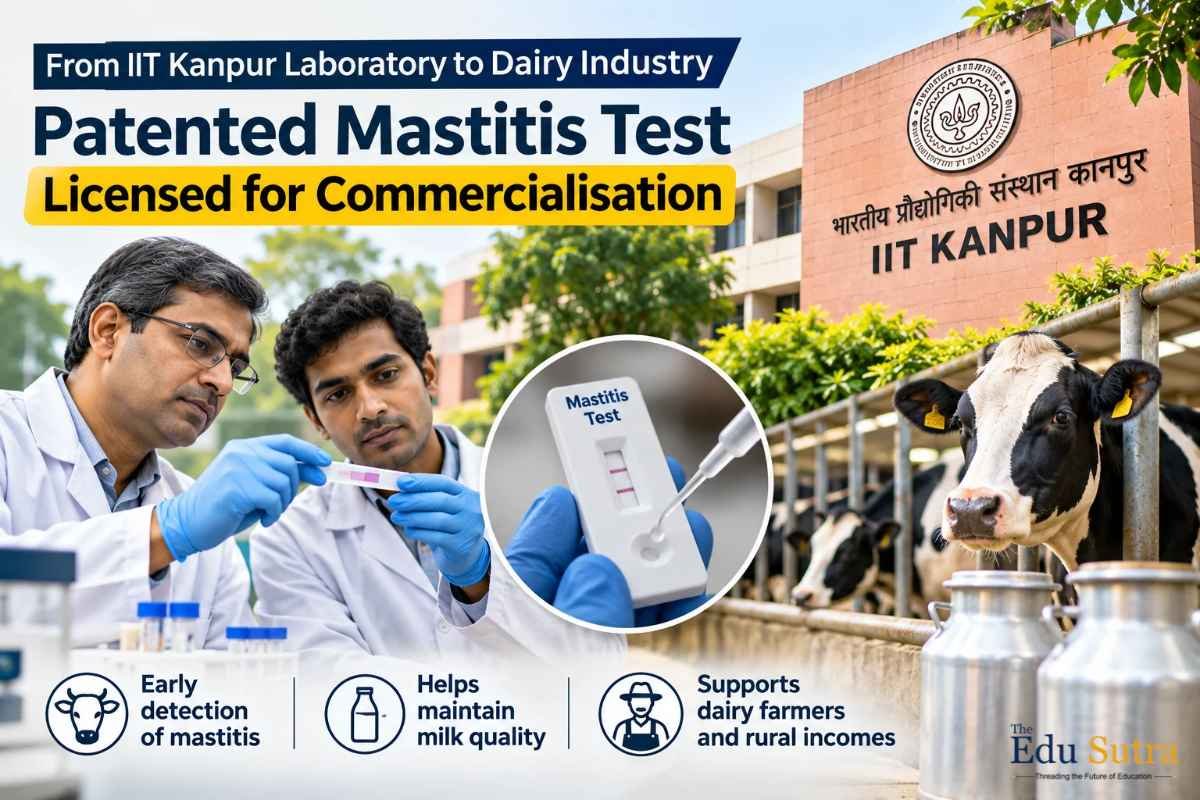
A research innovation developed at the Indian Institute of Technology Kanpur has taken an important step towards practical use in India’s dairy sector. A patented diagnostic technology designed to help detect mastitis in dairy animals has been licensed to Prompt Equipments, a company working in dairy technology.
Mastitis, an inflammation of the mammary gland, is a persistent concern for dairy farmers. It can affect milk quality and production, increase veterinary expenses and disrupt the livelihoods of families dependent on livestock. Early identification is important because delayed attention can make the disease more difficult and costly to manage.
The technology was developed by IIT Kanpur researchers Professor Siddhartha Panda and Dr Satyendra Kumar. The invention received Indian Patent No. 455232, and a technology licensing agreement with Prompt Equipments was reported in June 2024. The agreement marks a transition from academic research towards possible product development and distribution through an established industry participant.
For farmers, the appeal of a practical diagnostic strip lies in the possibility of identifying warning signs earlier and seeking veterinary guidance promptly. Such a tool could be particularly relevant in places where access to specialised laboratory testing is limited or where farmers must make quick decisions about animal care.
Also Read:- IIT Kanpur-Incubated ScaNxt Secures Fresh Investment as Its Farm Technologies Reach 21 States
However, a licence does not automatically mean that a product is being sold widely. Publicly available information reviewed for this story does not establish the number of diagnostic strips manufactured, sold or used by farmers. Nor does it demonstrate measured improvements in milk yield, farmer income or disease outcomes attributable to this invention. Those questions remain essential to evaluating its commercial and social impact.
Prompt Equipments’ experience in dairy-sector equipment offers a potential route to market, but the precise stage of product rollout requires confirmation. The distinction matters: a patented invention, a signed technology-transfer agreement and a commercially adopted product are three different milestones.
Also Read:- From IIT Bombay Laboratory to ₹62 Crore Revenue: India’s Homegrown Cancer Therapy Reaches Patients
The development nevertheless illustrates a significant role for India’s higher education institutions. Research can address problems that are not confined to laboratories, including the everyday challenges of livestock health, rural incomes and food quality. Collaboration with industry can help translate promising ideas into tools that farmers may eventually be able to obtain and use.
The next chapter of this IIT Kanpur innovation will be determined by evidence from the field: whether the diagnostic test becomes available at an affordable price, how accurately it performs under practical conditions, and how many dairy farmers actually adopt it. For Campus to Commerce, that journey from a patented research result to demonstrated use is the story worth following.