For many people, travelling to work, visiting a market or meeting friends is an ordinary part of everyday life. But for thousands of wheelchair users in India, these simple journeys can present enormous challenges.
An innovation emerging from the Indian Institute of Technology Madras is helping change that reality.
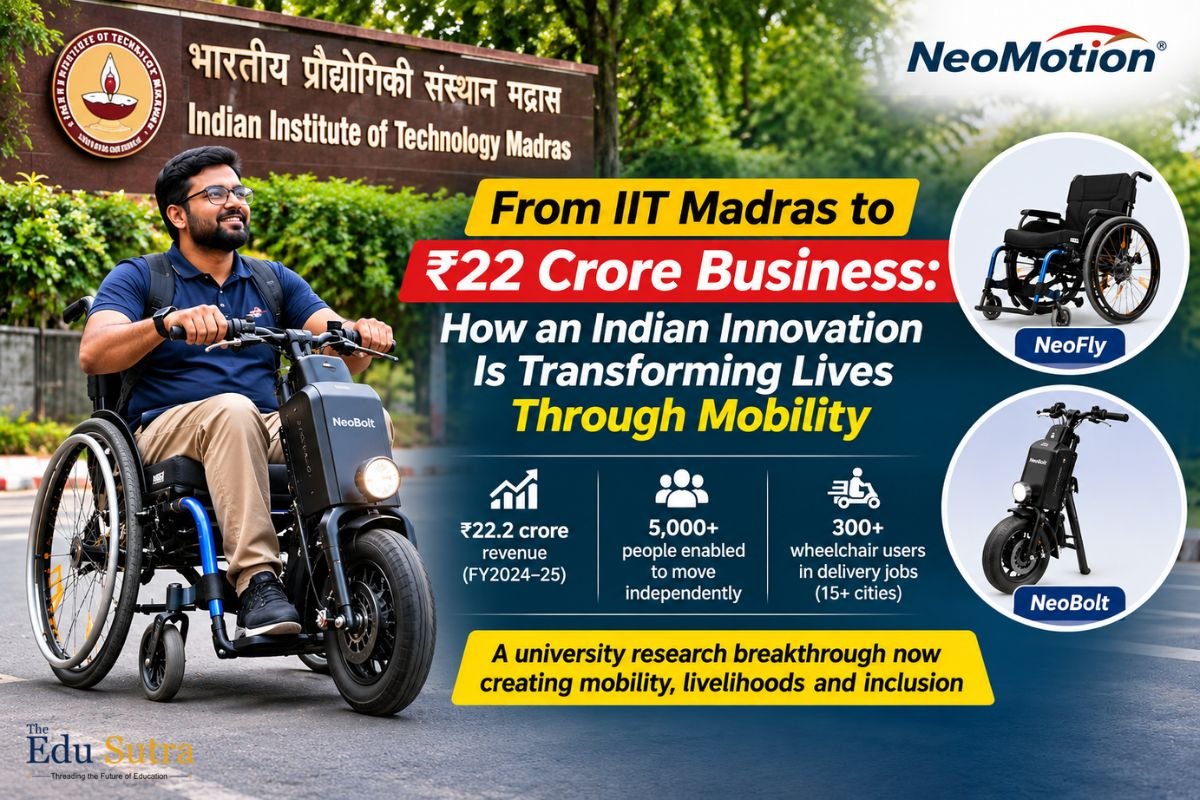
NeoMotion, a startup developed through the IIT Madras research and incubation ecosystem, has transformed the conventional wheelchair into a personalised mobility solution. Its products are helping people with physical disabilities travel independently, pursue employment and participate more actively in society.
The company has also demonstrated that socially meaningful technology can become a commercially viable business.
According to financial information reported by Inc42, NeoMotion recorded revenue of approximately ₹22.2 crore in the financial year 2024–25, compared with ₹17.6 crore in the previous year. It also reported a profit after tax of approximately ₹1.8 crore.
Also Read:- IIT Kharagpur and Tripura Join Hands to Strengthen Higher Education, AI Research and Student Careers
Behind those numbers is a story of Indian engineering addressing a challenge that conventional mobility products have often overlooked.
The Research That Started It All
The innovation traces its origins to the TTK Center for Rehabilitation Research and Device Development at IIT Madras, led by Professor Sujatha Srinivasan of the Department of Mechanical Engineering.
Researchers working with wheelchair users discovered that many conventional wheelchairs were not designed for India’s everyday conditions.
Narrow entrances, uneven roads, difficult terrain and poorly fitting equipment often limited mobility rather than enabling it.
The team recognised that people needed more than a standard wheelchair. They needed equipment designed around their bodies, surroundings and daily requirements.
That understanding led to the development of NeoFly, a personalised wheelchair, and NeoBolt, a motorised attachment that converts the wheelchair into an outdoor mobility vehicle.
NeoMotion began its commercialization journey in 2016, with its products reaching users in the following years.
A Wheelchair That Can Travel on Indian Roads
NeoFly is designed to accommodate individual physical requirements through multiple customisation options.
Its ergonomic construction allows users to move more efficiently while providing improved comfort and manoeuvrability.
NeoBolt takes the innovation further.
The motorised attachment connects to NeoFly, enabling users to travel outdoors without transferring to another vehicle.
The original NeoBolt system was designed to travel at speeds of up to 25 kilometres per hour, with a range of approximately 25 kilometres on a single charge.
For a wheelchair user who previously depended on someone else for outdoor travel, such technology can represent a significant improvement in independence.
From Mobility to Employment
Perhaps the most meaningful achievement of NeoMotion is the way its technology has created livelihood opportunities.
Through its Livelihood on Wheels initiative, the company has helped wheelchair users participate in delivery services and other income-generating activities.
The initiative has worked with delivery platforms, including Zomato, to support employment opportunities for people with physical disabilities.
According to the international Zero Project’s documentation, more than 300 people were working as delivery partners across over 15 Indian cities by 2024.
The programme demonstrated that assistive technology could do more than improve physical mobility. It could help remove barriers to economic participation.
For beneficiaries, the opportunity to travel independently and earn an income can have an impact that extends to their families and communities.
Thousands of Users, A Growing Commercial Enterprise
NeoMotion’s journey also illustrates the commercial potential of university research.
According to IIT Madras Research Park’s annual reporting, NeoMotion had enabled more than 5,000 people with disabilities to move independently across India.
The report also highlighted support for more than 1,500 beneficiaries during 2024–25 through partnerships with over 50 corporate social responsibility organisations.
A separate May 2025 report by YourStory placed the company’s user base at more than 6,500.
Alongside its social impact, NeoMotion has built a revenue-generating business.
Its reported ₹22.2 crore revenue in FY2024–25, representing growth of approximately 26 percent over the preceding financial year, provides evidence that the innovation has progressed beyond the research and prototype stage.
The company has also expanded its product development efforts, including work on standing wheelchairs and other assistive mobility solutions.
The Role of IIT Madras in Bringing Research to Market
NeoMotion’s development reflects the importance of university research ecosystems that support commercialization.
The TTK Center at IIT Madras combines engineering research with practical field testing, involving wheelchair users, rehabilitation specialists and other stakeholders.
The centre has transferred technologies to industrial partners, including NeoMotion.
Its research activities span wheelchairs, prosthetics, rehabilitation robotics and other assistive devices.
The broader research centre reports 11 granted patents and 10 pending patent applications across its portfolio. These figures relate to the centre as a whole and should not be interpreted as patents exclusively belonging to NeoMotion.
IIT Madras has also identified patented design features associated with the NeoBolt mobility system.
The journey demonstrates why successful commercialization requires more than obtaining a patent. Research must be translated into products that people can use, businesses can manufacture and customers or institutional partners are willing to purchase.
When Innovation Creates Social Value
India’s higher education institutions produce significant research and technological ideas every year. Yet only some innovations successfully make the transition from academic laboratories to commercial markets.
NeoMotion offers an example of what that transition can achieve.
Its products address a practical mobility challenge, its business has demonstrated commercial activity, and its livelihood initiatives have helped people with disabilities access new economic opportunities.
The company’s experience also highlights continuing challenges around affordability, accessibility, after-sales support and the availability of appropriate assistive technology across India.
As universities, researchers and entrepreneurs increasingly focus on real-world applications, innovations such as NeoMotion show how engineering can contribute to both economic development and social inclusion.
For the thousands of people whose daily mobility has improved, the achievement is not simply the development of another technological product.
It is the possibility of travelling independently, reaching a workplace and participating in everyday life with greater freedom.
That is the promise of taking innovation from campus to commerce.