
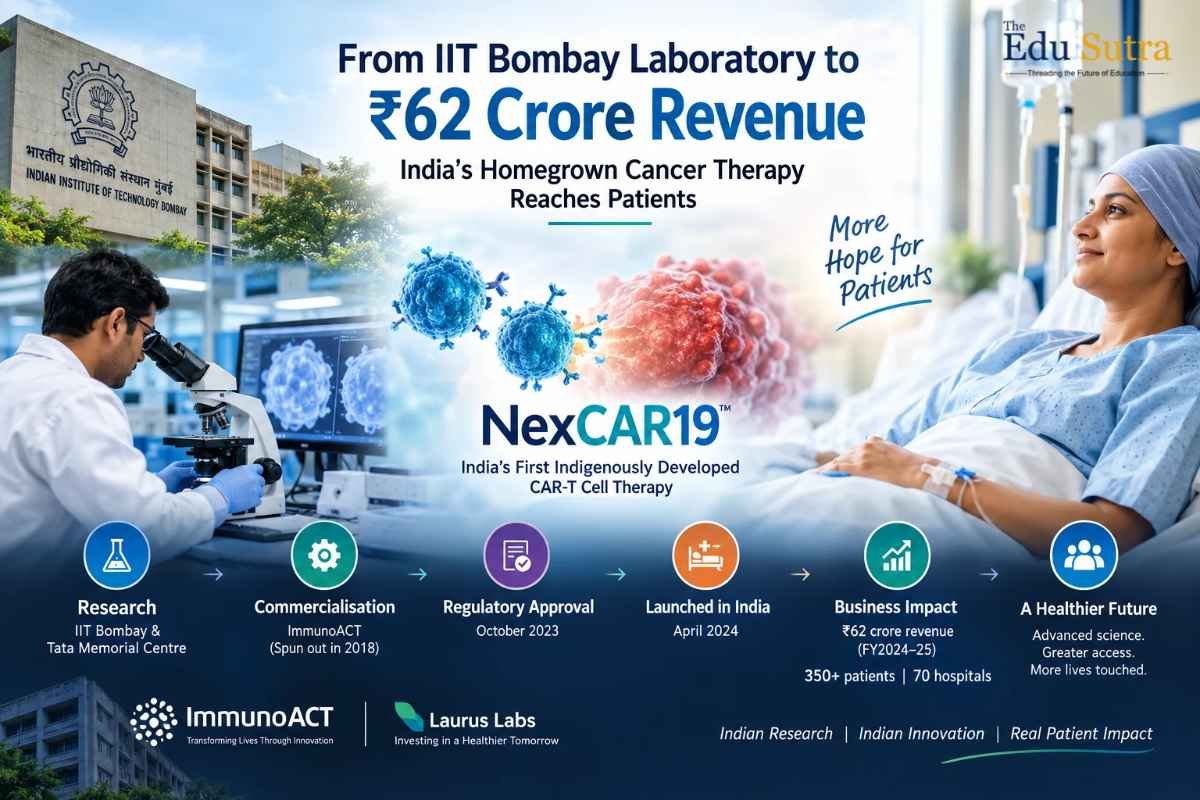
A treatment developed through years of research at IIT Bombay and Tata Memorial Centre has moved beyond the laboratory into hospitals, offering a new option to some patients with difficult-to-treat blood cancers. The journey of NexCAR19 also demonstrates how academic research can become a commercial enterprise while addressing a major healthcare challenge.
NexCAR19 is India’s first indigenously developed CAR-T cell therapy to receive regulatory approval. The treatment was approved in October 2023 and formally launched in April 2024. It is designed for selected patients with certain relapsed or refractory B-cell cancers, including forms of lymphoma and acute lymphoblastic leukaemia.
How the research reached patients
Professor Rahul Purwar and his team at IIT Bombay’s Department of Biosciences and Bioengineering worked with clinicians at Tata Memorial Centre, including Dr Hasmukh Jain and Dr Gaurav Narula. Researcher Alka Dwivedi and other members of the scientific team contributed to the development of the therapy. ImmunoACT, a company spun out of IIT Bombay in 2018, became the commercialization partner.
CAR-T treatment begins with collecting a patient’s immune T cells. In a specialised laboratory, the cells are modified to recognise a target on cancer cells, multiplied and then infused back into the patient. The process is complex, requires specialist medical supervision and can cause serious adverse effects. It is not a general treatment for all cancers.
The first patient in the Indian clinical programme received an infusion at Tata Memorial Hospital in June 2021. The therapy subsequently underwent clinical evaluation before receiving regulatory clearance. In April 2024, President Droupadi Murmu formally launched the homegrown therapy at IIT Bombay, marking a major milestone for collaboration between research institutions, hospitals and industry.
Commercial success with measurable adoption
The business case is supported by more than a patent announcement or a laboratory prototype. In July 2025, The Economic Times reported that ImmunoACT had generated ₹62 crore in revenue and ₹12 crore in profit before tax during FY2024–25, its first full year of commercial operations. The report also stated that NexCAR19 had been administered to more than 350 patients across 70 hospitals in India by that time. These are historical figures reported in July 2025, not newly announced results for November 2026.
Also Read:- From IIT Madras to ₹22 Crore Business: How an Indian Innovation Is Transforming Lives Through Mobility
Hyderabad-based pharmaceutical company Laurus Labs held a substantial minority stake in ImmunoACT, illustrating how industrial investment helped an academic technology reach commercial production. The treatment’s reported price of around ₹30 lakh per infusion was considerably below prices commonly quoted for comparable CAR-T therapies in the United States, although it remains beyond the financial reach of many Indian households.
What it means for patients
For patients whose cancers have returned or stopped responding to conventional treatment, CAR-T therapy can offer another possibility. Early Indian clinical trial results reported by the US National Cancer Institute showed responses in a substantial proportion of evaluable participants. Those findings are encouraging, but a response is not the same as a guaranteed cure, and long-term outcomes depend on the disease and individual patient.
The larger significance of NexCAR19 is that India has developed local expertise in advanced cell therapy, including research, clinical trials, manufacturing and hospital delivery. Building this capability could help make future treatments more accessible, provided costs, safety monitoring, treatment capacity and equitable access continue to improve.
Beyond the patent certificate
NexCAR19 is based on proprietary scientific work, but the precise granted patent numbers and ownership across jurisdictions have not been independently established for this article. Its commercial achievement is instead demonstrated by regulatory approval, actual patient treatment and reported operating revenue.
Also Read:- From IIT Kanpur to 700 Hospitals: How an Indian Ventilator Startup Built a Business Around Critical Care
The project offers an important lesson for universities and research institutions. Scientific discovery is only the beginning. To make a meaningful difference, an invention must pass through testing, regulatory scrutiny, manufacturing, financing and real-world use.
For IndiGlobal Campus to Commerce, NexCAR19 represents precisely that transition: research conducted in an Indian academic institution, developed alongside clinicians, brought to market by a domestic enterprise and used in the care of patients. Its success is not measured only in crores of revenue, but also in the new treatment option it has helped create.