
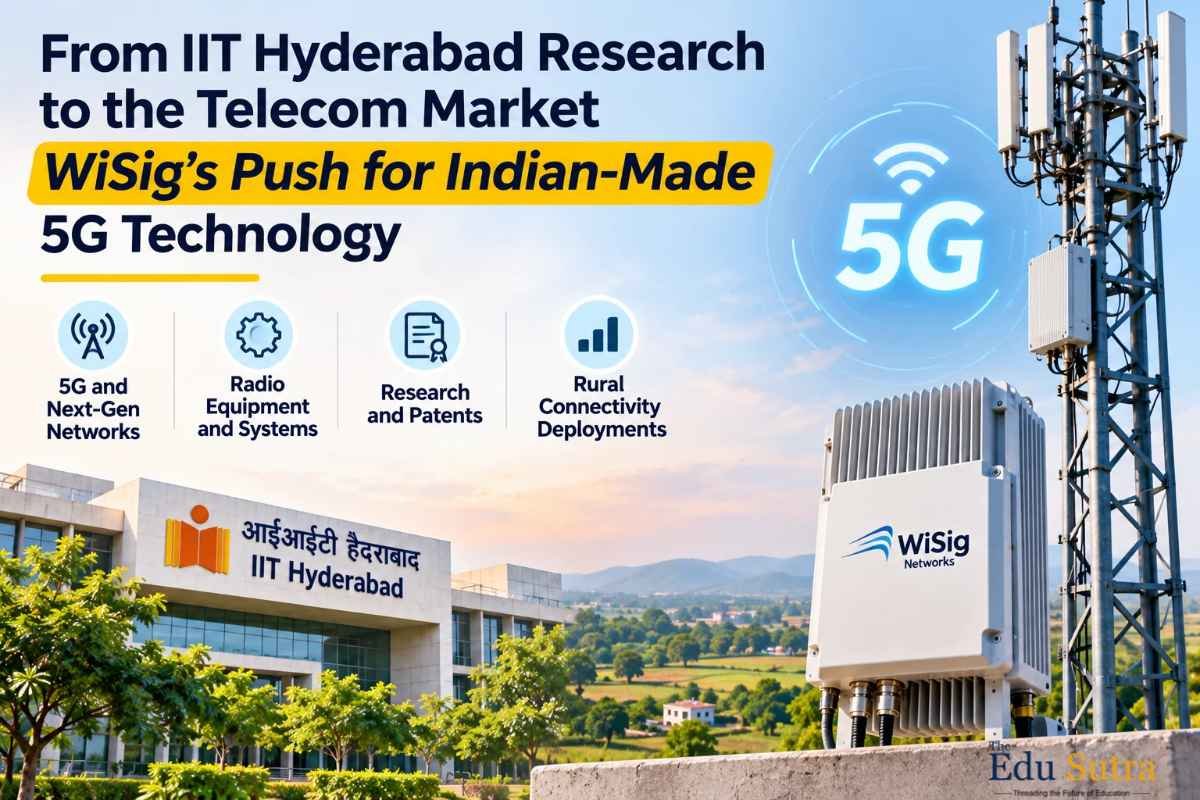
At a time when India is seeking to develop more of the technology behind its mobile networks at home, a company with roots in IIT Hyderabad research is working to turn wireless engineering into equipment and intellectual property for the telecom industry.
WiSig Networks, founded in 2016 by IIT Hyderabad professor Kiran Kumar Kuchi, develops wireless communication systems and technologies for advanced mobile networks. Its work spans radio equipment and research associated with 5G and next-generation connectivity.
The company represents a different side of campus innovation. Instead of a consumer product that people can hold in their hands, it works on the technology that enables networks to transmit information. Such systems must meet demanding performance requirements before operators can use them at scale.
WiSig has described field deployments involving rural connectivity and has reported commercial activity from its telecom technology. In October 2026, it announced that it was accepting commercial orders for a 32TR Massive MIMO radio system, with bulk shipments planned for 2027. Accepting orders is an important step, but it should not be mistaken for evidence that those future shipments have already been completed.
The business has previously reported cumulative revenue of about Rs 20 crore. That historical figure indicates commercial activity, although an updated audited revenue total and the number of paying customers for each product were not independently established.
Also Read:- IIT Kanpur-Incubated ScaNxt Secures Fresh Investment as Its Farm Technologies Reach 21 States
Patents form part of WiSig’s technology-development work, including documented patent activity involving IIT Hyderabad. But patent filings, granted rights and commercial sales are different milestones. The precise relationship between individual patents and each product in the market needs further verification.
For communities with limited connectivity, locally developed network technology could support more affordable and adaptable infrastructure. The extent of WiSig’s direct contribution to new household connections, however, has not been independently quantified.
The company’s journey also highlights the challenge facing research-led startups. Demonstrating a technology is only the beginning. Winning customers, manufacturing reliable equipment and supporting networks over many years are what ultimately turn engineering research into a sustainable business.
WiSig’s recent product-order announcement gives fresh relevance to a venture that began a decade ago. Its wider story is about the effort to move Indian wireless research beyond laboratories and demonstrations into the commercial telecom supply chain.