
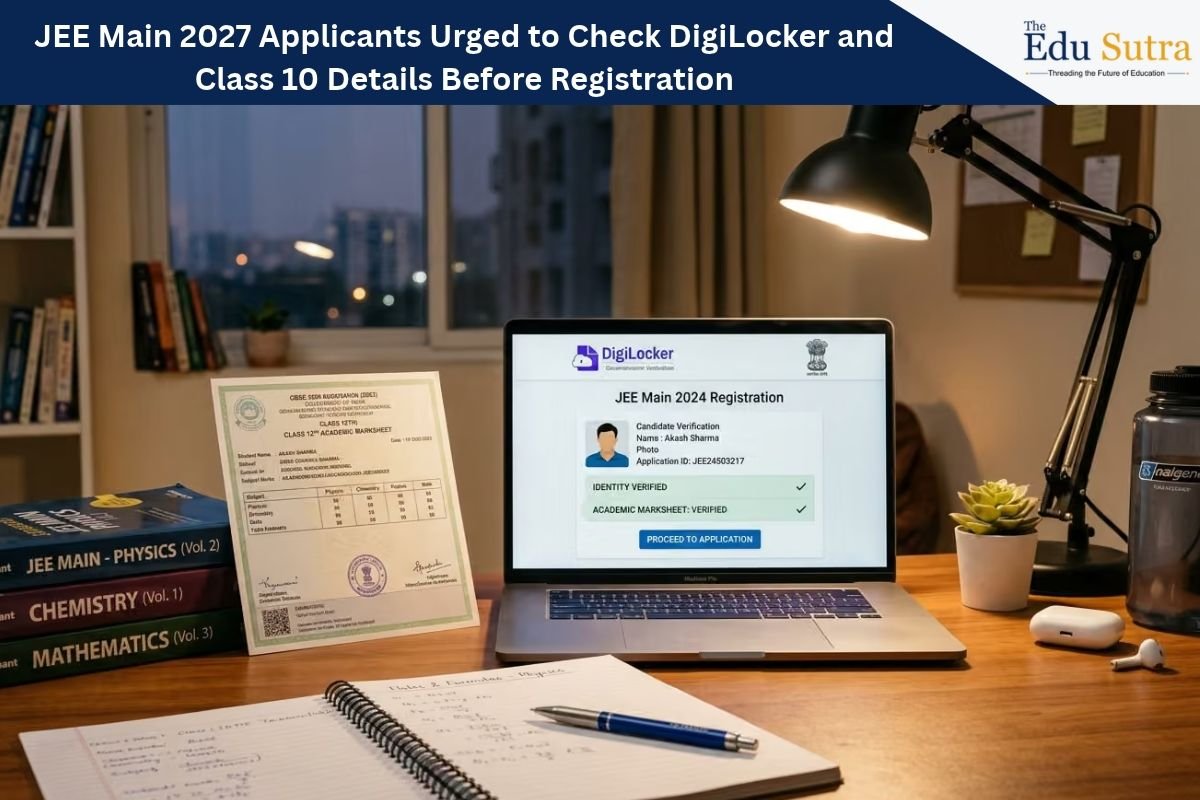
For engineering aspirants, an application error can become an avoidable source of stress long before the entrance examination begins. The National Testing Agency issued an advisory on October 29 asking JEE Main 2027 Session 1 candidates to check their digital identity records and personal details carefully before completing the application. The guidance is particularly relevant to students whose records have changed or whose names appear differently across documents.
Why DigiLocker verification matters
NTA has encouraged candidates to use supported identity services, including DigiLocker and JanParichay or e-Pramaan through Meri Pehchaan, for smoother verification. It has also advised applicants using DigiLocker to complete re-KYC so that updated information can be retrieved during registration. Candidates should follow the options actually presented in the application portal rather than assuming that any one method is mandatory for everyone.
Match the Class 10 certificate
One of the clearest instructions concerns the candidate’s name and date of birth. These details should match the Class 10 certificate or marksheet. Even a small inconsistency between identity records and academic documents can create questions at verification stages. Applicants should inspect spelling, initials, surname order and date formats before submitting the form.
A careful application checklist
Before beginning, candidates should keep their Class 10 details, active mobile number and email account available, review their DigiLocker profile if they intend to use it, and ensure that the photograph and other requested documents meet the current specifications. They should read the on-screen instructions, save the confirmation page and retain the payment acknowledgement after a successful submission.
Also Read:- UGC NET December 2026 Registration Closes October 31: Candidates Get Final Opportunity Without Late Fee
Important dates and the need to verify them
JEE Main 2027 Session 1 is scheduled for January 2027, with a second session planned for April. News reports published around the advisory have carried differing registration closing dates. Candidates should therefore rely on the deadline shown in the latest official NTA information bulletin and live application portal, rather than treating a date quoted in a secondary report as final. This article intentionally does not present an unverified closing date as settled.
What to do if details do not match
Students who notice a mismatch should first identify which document contains the discrepancy and consult the relevant issuing authority or the official examination helpdesk for guidance. They should not invent alternative spellings simply to complete a form. Any correction window announced by NTA has defined limits, and candidates should not assume that every field can be edited later.
The larger lesson for aspirants
Entrance examination preparation is usually discussed in terms of Physics, Chemistry and Mathematics, but administrative accuracy matters too. A few minutes spent checking identity details can reduce the risk of delays at application, admit-card or examination-centre verification stages.
EduSutra Perspective
Digital verification can make large examinations more efficient only when students receive clear instructions and have a fair opportunity to correct genuine mistakes. Schools and coaching centres can help by circulating official notices and encouraging candidates to check documents early, without spreading unnecessary alarm.