For students in Tripura, access to advanced laboratories, research mentorship and industry-oriented training can often depend on opportunities far beyond their home state. A new partnership between IIT Kharagpur and the Tripura government seeks to narrow that distance by bringing academic guidance and innovation support closer to local colleges and universities.
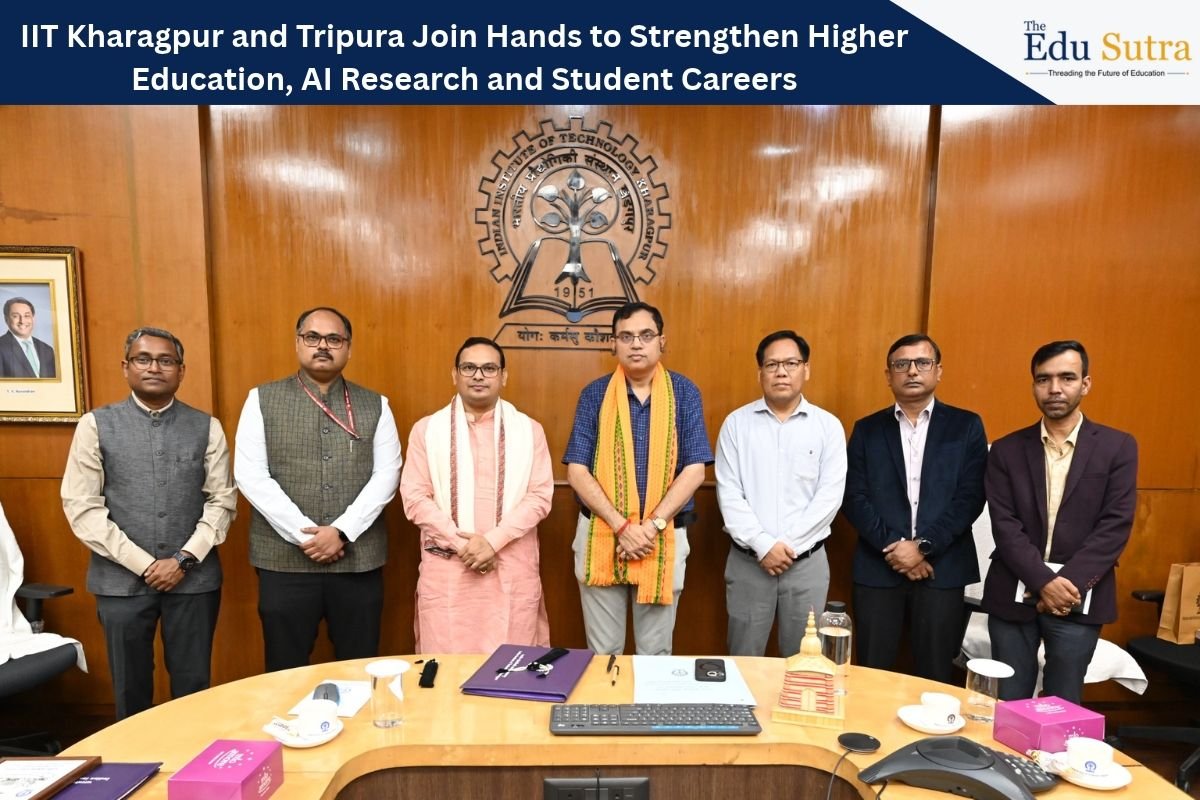
On 29 October 2026, IIT Kharagpur and the Higher Education Department of the Government of Tripura signed a Letter of Intent to establish a Centre for Advanced Learning, Research and Innovation, known as CALRI. The proposed centre is intended to support emerging-technology research, artificial intelligence-enabled education, digital learning, student and faculty development, entrepreneurship and startup incubation.
The Letter of Intent was signed in the presence of IIT Kharagpur Director Professor Suman Chakraborty and Tripura Higher Education Minister Kishor Barman. The announcement sets out a collaborative direction; it does not mean the centre is already operational or that admissions, jobs or funding have been guaranteed.
What the proposed centre could change
CALRI is envisaged as a multidisciplinary platform through which IIT Kharagpur can offer academic guidance and technical mentorship. For a student at a government degree college, the potential value lies in better access to updated teaching methods, applied projects and research exposure, provided the plans are translated into functioning programmes.
Also Read:- IIT Kharagpur Announces ₹35 Crore School of Physical AI, Opening New Frontier for Engineering Research
The initiative is also designed to help institutions integrate emerging technologies into teaching without treating technology as a substitute for foundational knowledge. Strong mathematics, science, communication and problem-solving skills will remain important alongside digital tools.
A focus on Tripura Technical University and government colleges
Under the proposed framework, IIT Kharagpur will mentor Tripura Technical University in curriculum modernisation, faculty development, research infrastructure, laboratory planning, accreditation, quality assurance and institutional governance. These areas can determine whether students encounter contemporary research and practical learning during their degree programmes.
Government general degree colleges across Tripura are also expected to be part of the effort through vocational courses, practical training, certification programmes, industry-aligned skills and entrepreneurship initiatives. The scope is broader than engineering alone: effective implementation could support students from several disciplines and academic backgrounds.
Research linked to the local economy
A distinctive part of the partnership is its emphasis on Tripura’s existing economic strengths, including bamboo, natural rubber, tea, agriculture and natural gas. Research connected to these sectors could help students work on real regional problems, such as improving processing methods, developing sustainable materials or creating technology-led enterprises.
That approach matters because successful research partnerships do not always begin with expensive equipment. They often begin with a practical question, a capable faculty mentor, reliable laboratory access and an organisation willing to test the resulting solution.
From placement statistics to sustainable opportunities
The collaboration places employability and entrepreneurship among its priorities. But the measure of success will be more demanding than the number of workshops organised or memoranda signed. Students and parents will reasonably want to know whether programmes produce credible certifications, paid internships, research opportunities, stronger placements and viable businesses.
The initiative has been described as a multi-year effort. A reported five-year roadmap is expected to involve project planning, governance and funding arrangements. Specific budgets, course openings, student eligibility criteria and launch dates should be treated as pending until formally notified by the participating institutions.
What students should watch for next
Students in Tripura should look for official announcements on the centre’s establishment, participating colleges, eligibility for training and research programmes, faculty exchanges, internship partnerships and any fee or scholarship arrangements. No separate application process for CALRI has been announced in the information available with the initial agreement.
EduSutra Perspective
The most promising aspect of this partnership is the possibility of bringing high-quality academic mentorship to students who may not otherwise study at an IIT. Its long-term value, however, will depend on transparent timelines, sustained investment, measurable student outcomes and opportunities that reach ordinary government colleges, not just a small group of institutions.
For Tripura, the opportunity is to turn a prestigious collaboration into a durable education ecosystem. The announcement is an important beginning; delivery will be the real test.