
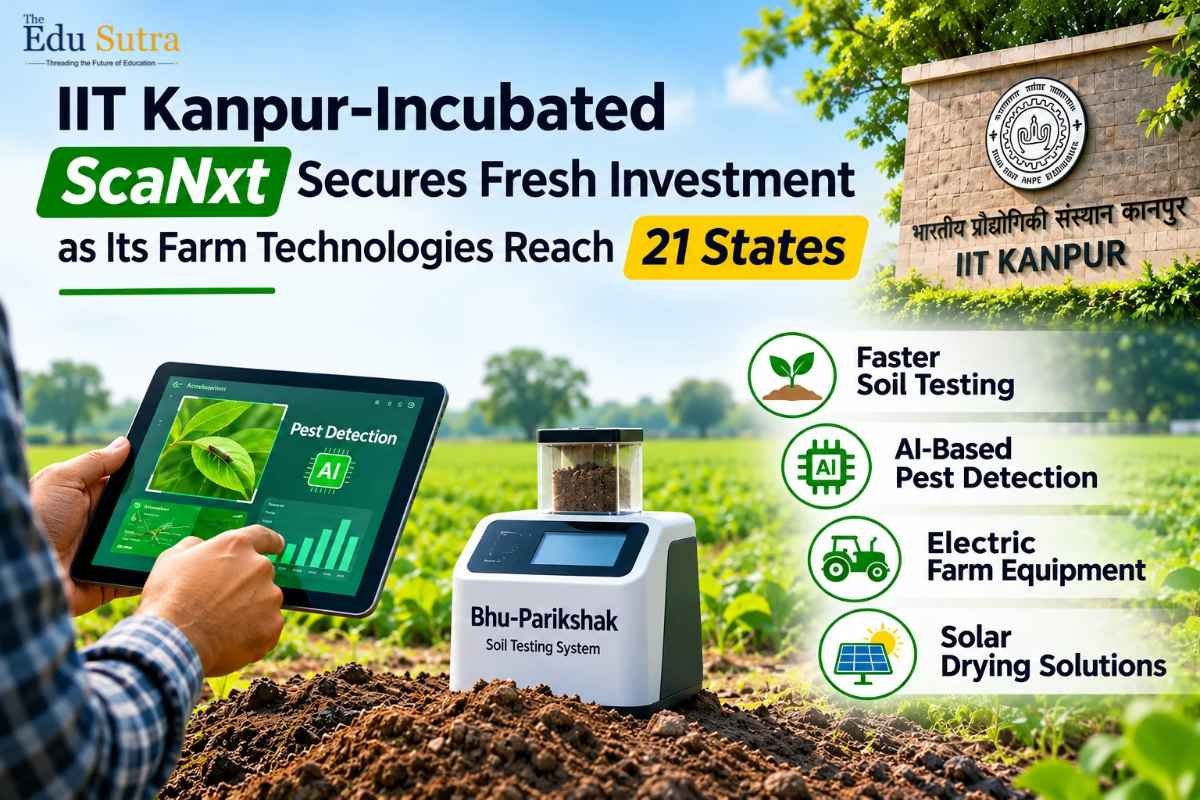
A technology venture supported by IIT Kanpur is drawing fresh investment as it works to take faster soil testing, artificial intelligence-based pest detection and affordable farm equipment to more farmers across India. ScaNxt Scientific Technologies has received investment from Rainmatter, the investment arm of Zerodha, along with the Small Industries Development Bank of India and the Export-Import Bank of India.
The company announced the development on November 5, and IIT Kanpur issued its statement on November 7. The amount invested has not been disclosed. ScaNxt plans to use the funding to develop its products, strengthen research, expand distribution partnerships and reach additional agricultural markets in India and overseas.
At the centre of its work is Bhu-Parikshak, a soil-testing system that uses near-infrared spectroscopy and machine learning to assess soil without the chemical reagents commonly used in laboratory tests. For farmers, the appeal is practical: obtaining useful information about soil conditions more quickly could help them make better decisions about crop nutrition and input use.
The startup is also developing pest-monitoring tools through its Detect technology and AgroLens platform. These systems aim to identify threats earlier and provide crop-related guidance. Its broader portfolio includes electric farm mechanisation and solar drying solutions, reflecting an attempt to address several everyday challenges in farming rather than focus on a single device.
Also Read:- From IIT Bombay Laboratory to ₹62 Crore Revenue: India’s Homegrown Cancer Therapy Reaches Patients
ScaNxt says nearly 90,000 farmers have registered with its platform and that it serves more than 200 business customers across over 21 states. The figures indicate that its technologies have moved beyond a laboratory demonstration and attracted commercial interest. However, registered users should not be confused with paying customers, and the company has not publicly disclosed its revenue, number of devices sold or the financial contribution of individual products.
The company is led by founder and chief executive Rajat Vardhan and is part of the incubation ecosystem supported by IIT Kanpur’s Foundation for Innovation and Research in Science and Technology. The institution describes the venture as an example of research-led innovation progressing towards a wider market.
The investment also reflects growing interest in technologies intended for smaller farms, where affordability and local support can matter as much as technical performance. Soil degradation, unpredictable pest attacks and the cost of agricultural inputs remain persistent concerns. Tools that offer timely information may help farmers respond more effectively, although independently measured gains in yields, income or fertiliser savings have not yet been established for ScaNxt’s products.
IIT Kanpur describes the company’s Detect technology as patented. The announcement does not identify a patent number or grant jurisdiction, so the precise legal status of that intellectual property remains to be confirmed. The broader commercial significance lies in the company’s reported business customers and geographic reach, rather than in a patent claim alone.
For ScaNxt, the next challenge will be turning wider access into sustained use. Farmers need technology that works reliably in different soil and crop conditions, is affordable to operate and can be serviced close to home. The fresh backing from Rainmatter, SIDBI and Exim Bank gives the company resources to pursue that expansion. Whether it can demonstrate measurable benefits on farms at scale will be the more important test of its long-term success.