

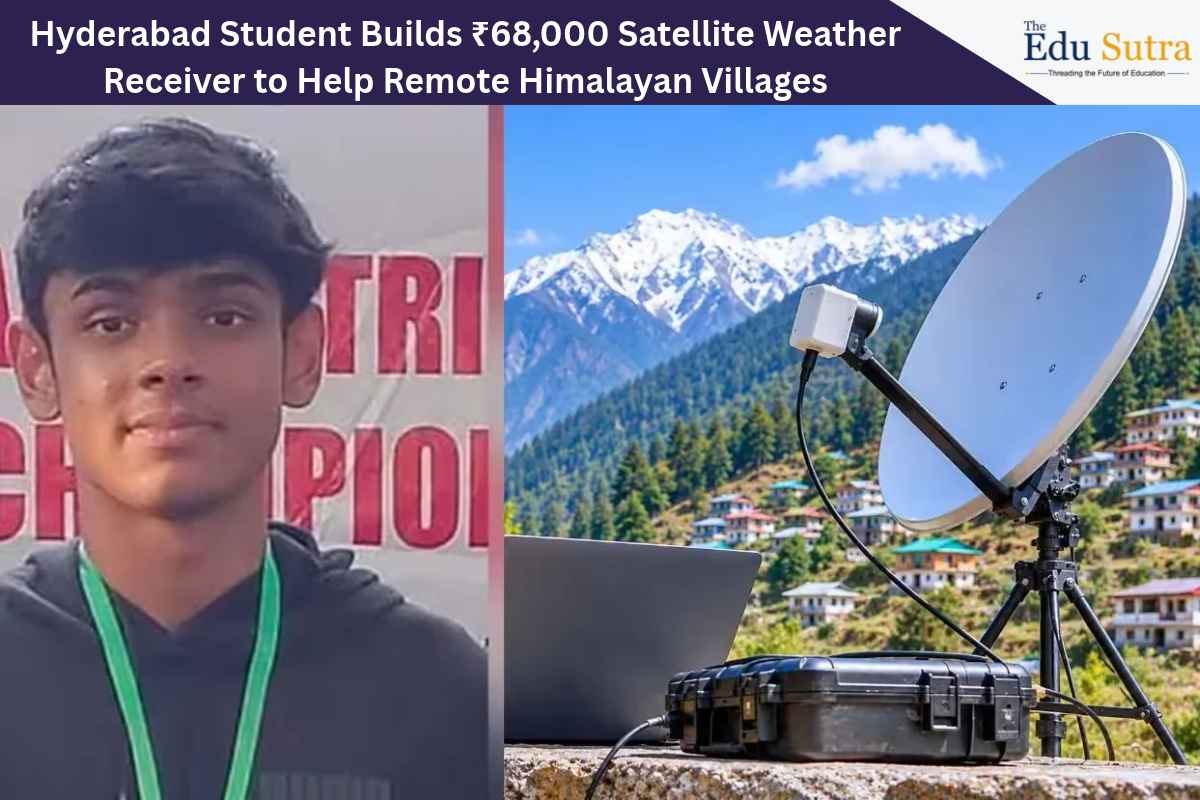
A Class 12 student from Hyderabad has developed a satellite-based receiver that can display weather-related cloud images without relying on an internet connection, offering a potentially useful source of information for remote mountain communities where mobile networks can become unreliable during severe weather.
Aagam Jain, a student and head boy at Indus International School, Hyderabad, developed the device, named SummitSathi, after experiencing poor connectivity during a mountain-climbing trip near Dehradun. Conversations with local residents about the challenges posed by changing weather prompted him to explore a practical way of accessing satellite imagery without depending on mobile data.
The receiver collects signals directly from weather satellites and converts them into cloud images that can be viewed locally. According to reports based on information shared by the school, each unit costs approximately ₹68,000. Unlike weather apps that need internet access to retrieve images, the device is intended to function independently of mobile networks.
Aagam initially tested the system near Dehradun and subsequently refined it. He also developed a simple grading approach to help users interpret the imagery. The project is aimed at making information easier to access for people who may not have technical training.
The student is preparing to provide the receivers free of charge to communities in Himachal Pradesh’s Mandi district, with plans involving ten villages. The proposed distribution should not be confused with completed installation or proven large-scale deployment; further field use will be important in establishing how well the equipment performs under difficult mountain conditions.
Also Read:- When Campus Job Offers Are Withdrawn: IIT Action Puts Student Protection in Focus
The distinction between satellite imagery and a weather warning is particularly important. SummitSathi is not an automated forecasting system and does not predict cloudbursts. Cloud images alone cannot reliably establish when or where a dangerous event will occur. Residents must continue to rely on official meteorological forecasts, warnings and local disaster-management instructions.
Beyond this project, Aagam has pursued astronomy-related activities, including a study of night-sky brightness across locations in Hyderabad and an independently published astrophotography book, A Window to the Universe. His latest effort brings that interest in observation and technology to a problem encountered outside the classroom.
The project highlights the value of encouraging students to test ideas against real community needs. Its longer-term impact will depend on successful deployment, training, maintenance and how effectively local users can interpret the information. For now, the Hyderabad student’s initiative offers an example of school-level scientific curiosity being directed towards a practical public-interest challenge.