
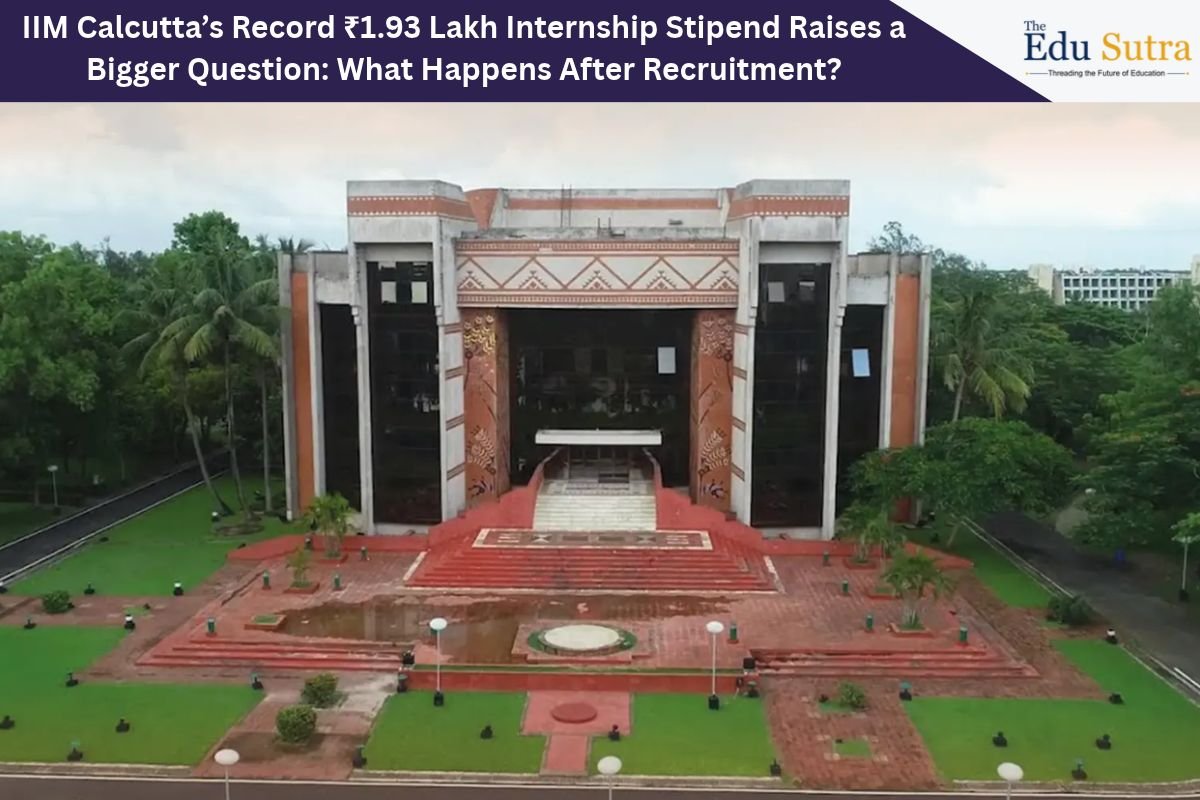
IIM Calcutta reported full summer internship placement for the 63rd batch of its two-year MBA programme in an announcement reported on October 27, 2026. All 475 participating students secured placements, with 546 offers from 156 companies. The institute reported a record average monthly internship stipend of ₹1.93 lakh and a median of ₹2 lakh.
These figures signal strong employer interest in the institution’s students. Yet an internship placement is not the same as a permanent job, and a short-term stipend is not a promise of future annual salary. For families weighing the cost of management education, that distinction is essential.
What the recruitment numbers actually show
Consulting accounted for 220 offers, approximately 40 percent of the total, while finance contributed 127. General management and marketing accounted for 158 offers. The spread of employers and roles points to substantial demand across several business functions.
Also Read:- UGC NET December 2026 Correction Window Closes November 4: What Applicants Can Still Change
The figures do not, however, reveal how many students will receive pre-placement offers after their internships, how many will accept them or how those graduates will fare in the first years of full-time employment. Those outcomes must be tracked separately.
An internship stipend is not annual salary
A monthly stipend of ₹1.93 lakh, even when described as an average, applies to the internship arrangement and its duration. Multiplying it by twelve would produce a misleading estimate of a graduate’s annual compensation. Full-time packages may include fixed salary, performance-linked bonuses, joining payments or other components.
Students comparing offers should distinguish the amount reliably paid each month from conditional or deferred compensation. They should also consider living costs, loan repayments and the nature of the work rather than relying on a single headline number.
The missing measures of sustainability
A stronger measure of placement success would follow the same cohort beyond recruitment. What proportion of interns secure pre-placement offers? How many obtain permanent employment through final placements? How many remain with their employer after one, two or three years? How do responsibilities and fixed compensation progress?
Such information would help students judge the return on their education investment. It would also help employers and institutions understand whether a strong placement season translates into durable careers. The currently reported summer placement figures do not answer those questions, and they should not be interpreted as evidence of poor retention or unstable employment.
What MBA aspirants should ask
Prospective students should seek audited or clearly defined placement statistics, including median fixed compensation where available, the range of roles, the share of variable pay and information about career support after graduation. Alumni conversations can provide context about workload, mentorship and mobility, although individual experiences should not be treated as representative of an entire batch.
The right question is not whether a high stipend is impressive. It is whether the programme helps graduates develop skills and opportunities that remain valuable as industries, technology and hiring conditions change.
EduSutra Perspective
IIM Calcutta’s summer placement achievement deserves recognition. Equally, students and parents deserve a fuller picture of what happens next. Celebrating recruitment success and asking for long-term career evidence are complementary, not contradictory, responsibilities of education reporting.