
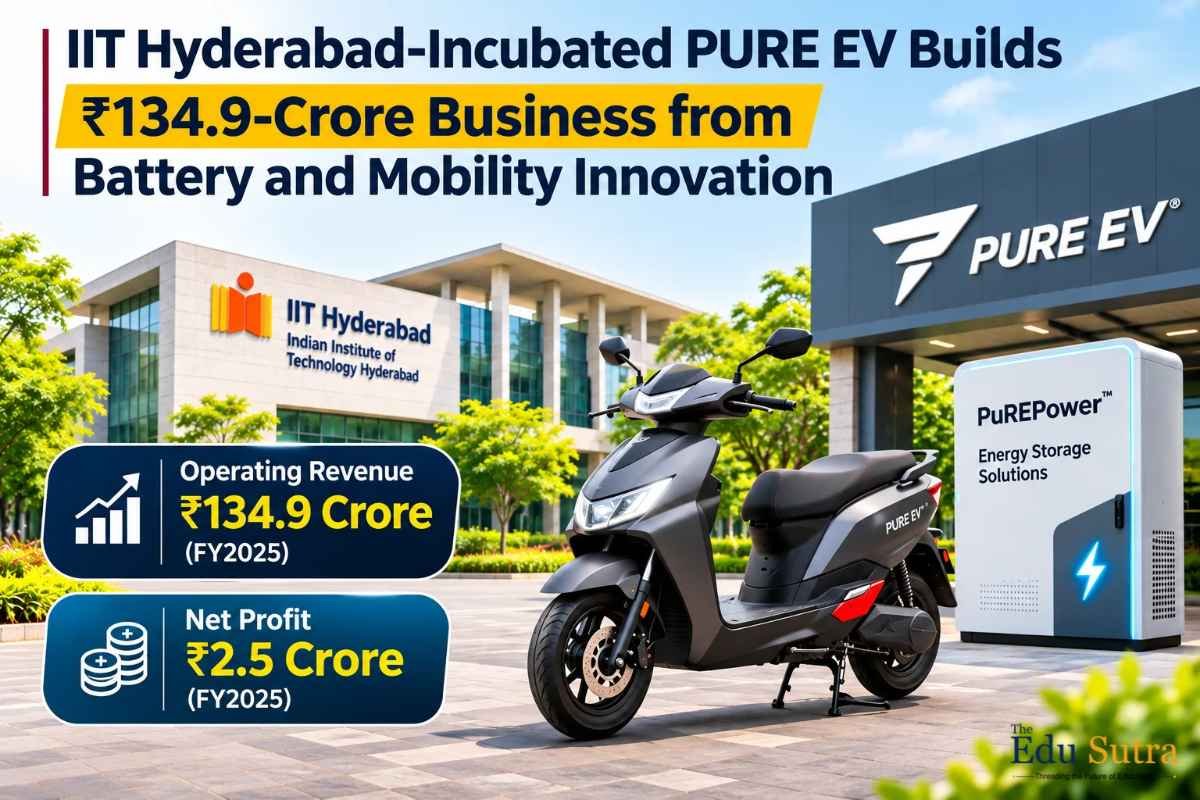
An idea nurtured in the research and incubation ecosystem of the Indian Institute of Technology Hyderabad has grown into a business selling electric scooters and energy-storage products across India. PURE EV, founded by Dr Nishanth Dongari and Rohit Vadera, offers a compelling example of how engineering research can move beyond campus laboratories and find customers in a competitive market.
The Hyderabad-based venture reported operating revenue of ₹134.9 crore for the financial year ended March 31, 2025, compared with ₹123.6 crore in the previous year. Its net profit rose to approximately ₹2.5 crore. More than ₹123 crore of the operating revenue came from vehicle sales, making electric two-wheelers the main commercial driver of the business.
Those figures matter because many promising inventions never make the transition from prototype to paying customers. PURE EV has moved into manufacturing, distribution and after-sales operations, although its experience also demonstrates how difficult it is to build a sustainable enterprise in India’s fiercely competitive electric-vehicle market.
The company’s origins are closely tied to IIT Hyderabad. Dongari, an associate professor associated with the institute, and Vadera developed a venture centred on battery technology before expanding into electric two-wheelers. The institute’s incubation and research facilities helped the company test ideas and develop products suited to Indian road conditions and consumer requirements.
Also Read:- From IIT Hyderabad Research to the Telecom Market: WiSig’s Push for Indian-Made 5G Technology
An early milestone came in February 2020, when PURE EV introduced its EPluto 7G electric scooter at IIT Hyderabad. The launch signalled a shift from technology development towards consumer mobility. The company subsequently built a portfolio of electric scooters and motorcycles while continuing work on battery systems.
The commercial journey has not been limited to vehicles. In March 2025, PURE announced an expansion into energy-storage solutions for homes, businesses and potentially grid applications under the PuREPower brand. Its manufacturing operations near the IIT Hyderabad campus reflect an effort to connect research, product development and production within the region.
For consumers, electric two-wheelers offer an alternative to petrol-powered commuting. For the wider economy, local design, battery-system engineering and manufacturing can support technical employment and strengthen domestic capabilities. Energy-storage products could also help households and businesses make better use of electricity, including renewable power, depending on how they are deployed.
PURE EV has reported substantial cumulative vehicle sales and environmental benefits. Such company-reported estimates should be distinguished from independently verified measurements. Likewise, while the venture has a strong research and innovation background, the publicly available evidence reviewed for this story does not establish that a particular granted patent generated the company’s reported revenue.
The company’s FY2025 results provide clearer proof of market adoption: customers bought its products, vehicle sales generated significant income and the business reported a profit for that year. They do not, by themselves, guarantee future growth or prove that every technology initiative has reached commercial scale.
For students and researchers, the larger lesson is that innovation does not end when a device works in the laboratory. It must be engineered for everyday use, manufactured reliably, supported after purchase and accepted by customers. PURE EV’s journey from the IIT Hyderabad ecosystem to a revenue-generating enterprise shows what that demanding transition can look like.
This is an established commercialisation story, not a newly announced breakthrough. Its significance lies in the longer journey from campus-linked engineering to products on Indian roads and in homes—and in the measurable business activity that followed.