
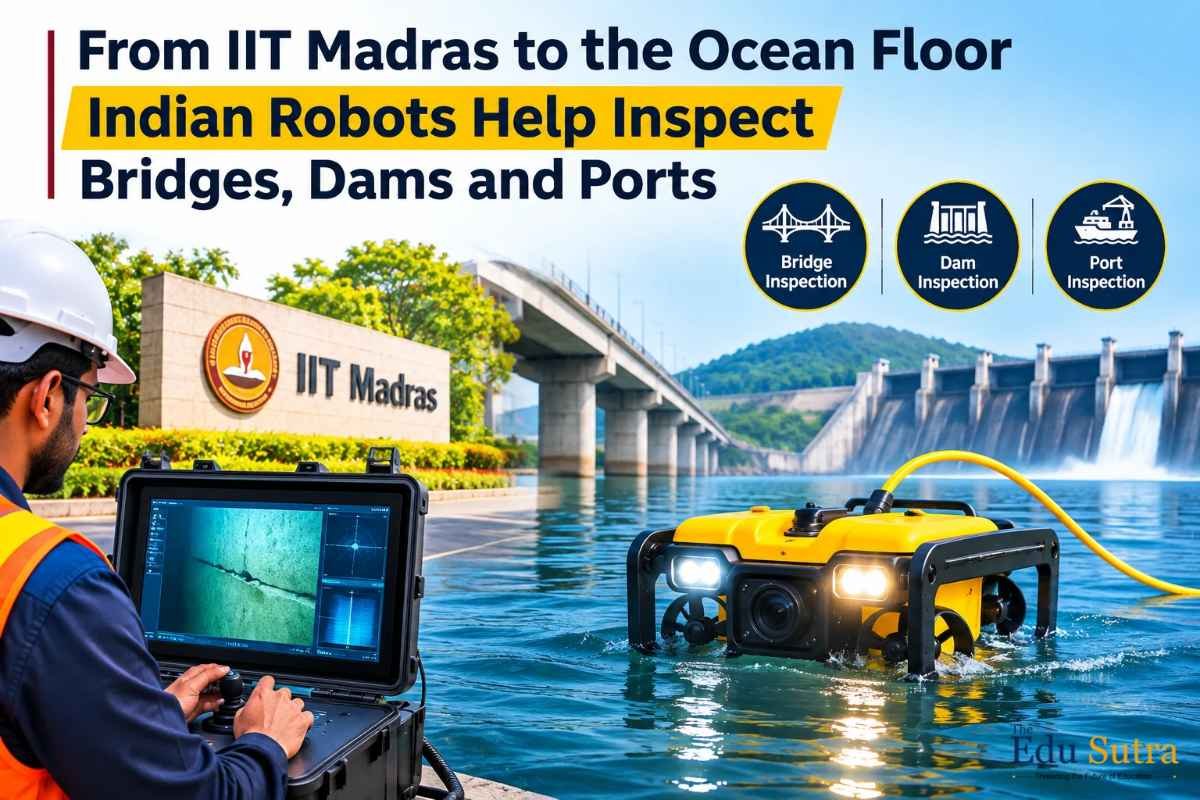
Beneath a busy bridge or a vast dam lies a part of our infrastructure that most people never see. Yet cracks, corrosion and other defects in submerged structures can pose serious maintenance challenges. An Indian company born from research at IIT Madras is helping engineers examine these difficult-to-reach places using underwater robots.
Planys Technologies, founded in 2015 by IIT Madras alumni and faculty, has built a commercial business around remotely operated underwater vehicles and digital inspection tools. Its founders include Tanuj Jhunjhunwala, Vineet Upadhyay, Rakesh Sirikonda and professors Prabhu Rajagopal and Krishnan Balasubramaniam. The venture emerged from work connected with the institute’s Centre for Non-Destructive Evaluation.
Instead of relying exclusively on divers to inspect submerged structures, the company sends robotic systems equipped with cameras and specialised sensors into the water. The machines gather visual and testing information that engineers can examine to assess the condition of bridges, dams, ports, industrial plants and other assets. Such inspections can reduce the need to expose people to hazardous underwater environments, although specialist divers and engineers remain important to many operations.
The transition from laboratory work to paying customers is already documented. In December 2022, the Government of India’s Technology Development Board reported that Planys had completed more than 200 contracts across eight industries. It also announced support of ₹1.5 crore towards a ₹3.6 crore project to further commercialise remotely operated vehicles for infrastructure inspection.
Also Read:- From IIT Kanpur Laboratory to Dairy Industry: Patented Mastitis Test Licensed for Commercialisation
By April 2024, published industry reporting said the company’s technology had been deployed at more than 400 structures. Customers identified in that reporting included Reliance Industries, Indian Oil, Bharat Petroleum and Indian Railways. These figures relate to earlier milestones, not newly completed projects this week.
Planys has also pursued intellectual property protection for its technology. The government reported in 2022 that more than 30 patents had been filed or were in the process of filing. That figure should not be mistaken for 30 granted patents. The individual grant status of each invention has not been independently established here.
The company has continued expanding its industrial operations overseas. Reporting in December 2025 identified deployments in markets including Singapore, Saudi Arabia, the United Arab Emirates, Qatar and the Netherlands. It also reported a ₹100 crore funding round intended to support expansion and development of underwater systems. Funding is investment capital, not business revenue.
For infrastructure owners, the practical value is in obtaining clearer information about structures that are otherwise difficult to inspect. Earlier identification of defects can support maintenance planning and may help prevent costly failures. The extent of savings and safety improvements, however, varies by project and should not be assumed without measured evidence.
The Planys journey offers a compelling example of campus research becoming a commercial service. Its significance is not simply that engineers designed an underwater robot, but that customers have commissioned the technology for real inspections. As India invests in infrastructure, such research-led businesses show how innovations developed around universities can find a place in the wider economy.