
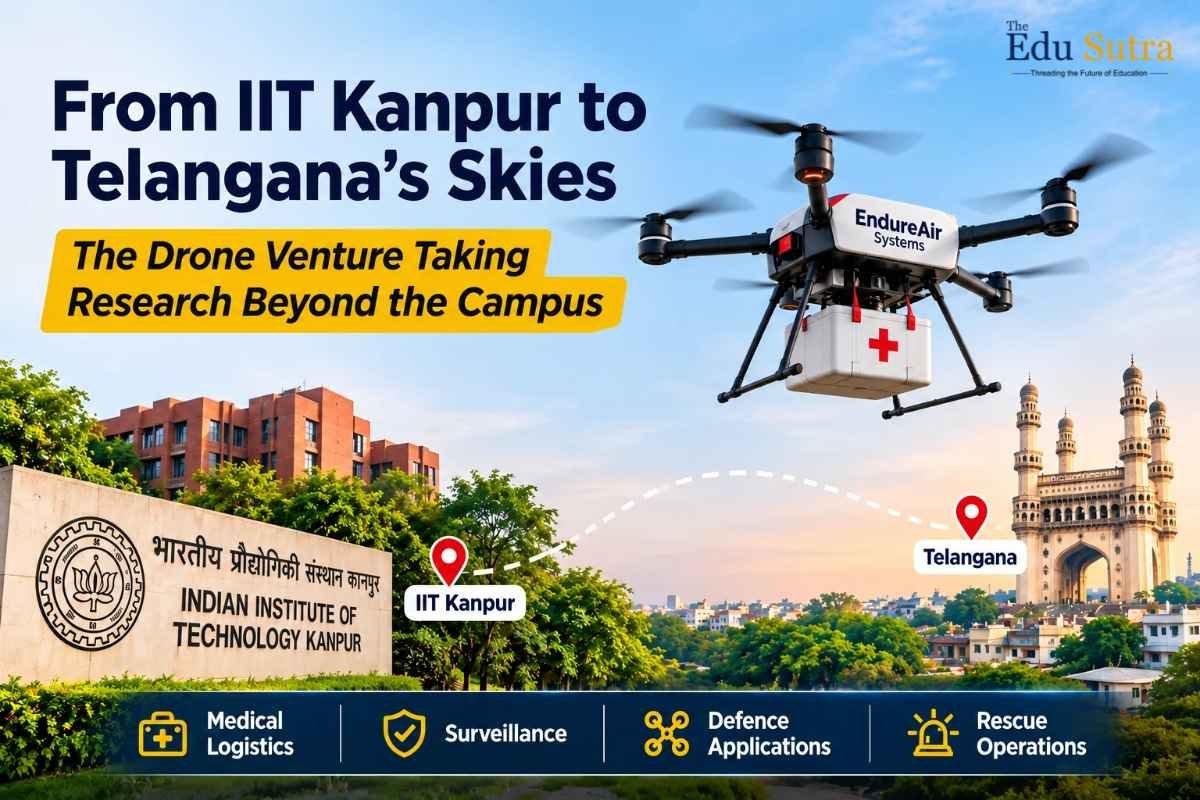
Imagine a remote community where an urgently needed medical package must travel along difficult roads. Could a drone offer another route? That question gives a human face to the work of EndureAir Systems, a company rooted in the research ecosystem of the Indian Institute of Technology Kanpur.
EndureAir develops indigenous unmanned aerial vehicles for applications that include logistics, surveillance and demanding field operations. Its journey illustrates a central promise of university-linked innovation: engineering ideas can become products designed for customers and public-service challenges outside the laboratory.
The company emerged in 2018 from an IIT Kanpur-linked team associated with rotorcraft research. Its aircraft portfolio includes the Vibhram, Alakh and Sabal platforms, designed for different operational requirements. Rather than treating a single demonstration as a finished business, the more important story is how the team moved from testing aircraft to developing systems intended for real-world users.
Also Read:- From IIT Kanpur Laboratory to Dairy Industry: Patented Mastitis Test Licensed for Commercialisation
One of the most relatable chapters unfolded in Telangana. EndureAir participated in the state’s Medicine from the Sky initiative, where drones were tested for medical logistics. Reporting on the programme described a medical-delivery demonstration over a distance of approximately 42 kilometres. It offered a glimpse of how aerial transport might help connect difficult-to-reach locations with essential supplies.
There is an important distinction: a successful demonstration does not mean that a permanent, statewide medicine-delivery network is operating. Routine service requires dependable aircraft, permissions, trained operators, weather planning, maintenance and a workable economic model.
Beyond medical logistics, EndureAir has reported defence-related supply activity and rescue-oriented applications. These uses point to a broader market for domestically engineered drones, although independently verified sales totals and current revenue were not available for this article.
The company’s intellectual-property work has also been discussed publicly, including a co-founder’s reference to eight patents. The precise patent grants and ownership details require confirmation before those figures can be treated as a verified portfolio.
For students and researchers, EndureAir’s story is about more than a flying machine. It shows the demanding transition from an idea to a field-ready product: repeated testing, engineering reliability, customer requirements and the discipline of commercial delivery.
For communities, the potential value is tangible. Drones may shorten some medical-logistics journeys, support teams during emergencies and reach places where conventional access is difficult. Whether those benefits become affordable and sustainable at scale will depend on evidence from continued operations.
That is the real Campus to Commerce question: not simply whether a drone can fly, but whether research-born technology can reliably solve a problem people are willing—and able—to pay to address.